Find more Shameless Screen Entertainment DVD reviews here.
The following is the third of three reviews for the "Shameless Slasher Nasties Box Set" - it's a 3-disc DVD comprised of Killer Nun, Torso, and Night-Train Murders.
Like Killer Nun (included in this box set), Aldo Lado’s
riff on Wes Craven’s The Last House on
the Left (1972) found its way
onto the Department of Public Prosecutions list of 72 banned video nasties in
the 1980s. However, similarly to Berruti’s film, Night Train Murders was later acquitted (33 titles in total were acquitted, leaving 39 that were ‘liable to
deprave and corrupt’ anyone who viewed them).

While the trailer seems to suggest a lurid and fast-paced
thriller, Lado’s ‘rape and revenge’
flick is in fact much more reliant on suspense and slow-build tension – and a
script loaded with brutal social commentary. Furthermore, despite Lado claiming
to have never seen Craven’s vicious Vietnam-weary The Last House on the Left (itself
heavily inspired by Ingmar Bergman’s 1959 film The Virgin Spring), there are numerous similarities between the
two films – two girls fall victim to a gang of thugs (one of whom is a junkie) only for them to in-turn fall victim to
the upper middle class parents of one of the victims (one of whom is a Doctor). That said, the two films differ in two
key ways – Craven’s documentary-like film is far more directly plotted, while
Lado’s visually luxuriant film possesses far more twisted characters.
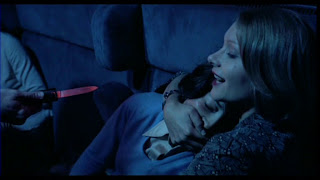
Opening amidst the heavily populated consumer haven of a
German shopping district on Christmas Eve, Lado’s social criticism gets off to
an early start – the safety of this scene getting interrupted when the two
antagonists (“Blackie” and “Curly”) mug
a boozy Santa Claus. They escape the police by hopping aboard a departing train
– the same train that is carrying Margaret and her friend Lisa on their way to
spend the holidays in Italy
– and so a night of depravity is set in motion.
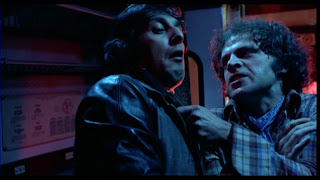
Amongst the passengers are a cross-section of 1970s European
society – including happy families, students, Catholic priests cheating at
chess, and a group of well-heeled adults discussing the very nature of
morality, democracy, and if there is a middle-ground between liberalism and
totalitarianism. Indeed it is within this last group that we meet one of the
key antagonists – ‘The Lady on the Train’ – an upper middle class woman who
hides her sexual perversions in her handbag and behind her veil. It is with
this character that the social criticism of the script is most potent,
unleashing her inner demons via a toilet-bound tryst with Blackie – in this way
depravity is almost treated like a sexually transmitted disease that brings out
the worst in her suppressed character. It’s quite literally a clash of the high
society and the seething proletariat.
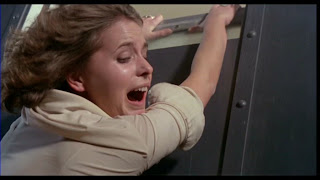
As the film progresses, the social commentary continues to
come thick-and-fast as the tension slowly builds – seemingly happy marriages
are shown to be on the rocks, and the very nature of temptation and shame are
embodied brilliantly in the figure of a bourgeois voyeur. Indeed, the film
really explodes once we’ve swapped trains and the central protagonists and
antagonists find themselves secreted away in a booth with each other – and it
is here that Ennio Morricone’s score (central
to which is a chilling, stalking harmonica) creates an almost unbearable
amount of anxiety as events take a dramatic and violent turn for the worse.
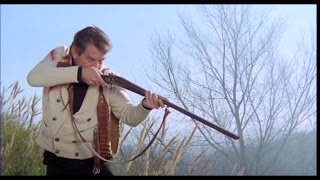
Cast in a sinister and seductive blue light, Gabor Pogany’s
cinematography expertly melds vice, violence, and virgin innocence, while
Alberto Gallitti’s exceptional editing fizzes with inspired cross-cutting and
sound design that blends two distinct worlds into a distillation of the
troubled underbelly of (at the time at
least) modern European life. While The
Last House on the Left focussed more on up-front violence, Night Train Murders instead opts for
chillingly lifting the veil on the potential moral squalor inside any one of us
– and it is precisely this kind of rich thematic texturing that proves Lado’s
film to be an extremely rewarding entry in the ‘rape and revenge’ sub-genre.
Shameless Screen Entertainment do themselves proud with a
clean and crisp transfer, and a nice audio presentation that preserves all of
the Godfather-like use of clattering
train wheels on the soundtrack; trailers round out the package. The 3-disc 'Shameless Slasher Nasties Box Set' also comes with an essay insert from noted film writer Kim Newman (providing brief but informative context), and the set itself comes with impressive cover art that mimics a rental videotape (complete with "Be Kind and Rewind" sticker).




 Posts
Posts

