Saturday, 21 January 2012

Night Train Murders (Aldo Lado, 1974)


Find more Shameless Screen Entertainment DVD reviews here. 

The following is the third of three reviews for the "Shameless Slasher Nasties Box Set" - it's a 3-disc DVD comprised of Killer Nun, Torso, and Night-Train Murders.


Like Killer Nun (included in this box set), Aldo Lado’s riff on Wes Craven’s The Last House on the Left (1972) found its way onto the Department of Public Prosecutions list of 72 banned video nasties in the 1980s. However, similarly to Berruti’s film, Night Train Murders was later acquitted (33 titles in total were acquitted, leaving 39 that were ‘liable to deprave and corrupt’ anyone who viewed them).


While the trailer seems to suggest a lurid and fast-paced thriller, Lado’s ‘rape and revenge’ flick is in fact much more reliant on suspense and slow-build tension – and a script loaded with brutal social commentary. Furthermore, despite Lado claiming to have never seen Craven’s vicious Vietnam-weary The Last House on the Left (itself heavily inspired by Ingmar Bergman’s 1959 film The Virgin Spring), there are numerous similarities between the two films – two girls fall victim to a gang of thugs (one of whom is a junkie) only for them to in-turn fall victim to the upper middle class parents of one of the victims (one of whom is a Doctor). That said, the two films differ in two key ways – Craven’s documentary-like film is far more directly plotted, while Lado’s visually luxuriant film possesses far more twisted characters.


Opening amidst the heavily populated consumer haven of a German shopping district on Christmas Eve, Lado’s social criticism gets off to an early start – the safety of this scene getting interrupted when the two antagonists (“Blackie” and “Curly”) mug a boozy Santa Claus. They escape the police by hopping aboard a departing train – the same train that is carrying Margaret and her friend Lisa on their way to spend the holidays in Italy – and so a night of depravity is set in motion.


Amongst the passengers are a cross-section of 1970s European society – including happy families, students, Catholic priests cheating at chess, and a group of well-heeled adults discussing the very nature of morality, democracy, and if there is a middle-ground between liberalism and totalitarianism. Indeed it is within this last group that we meet one of the key antagonists – ‘The Lady on the Train’ – an upper middle class woman who hides her sexual perversions in her handbag and behind her veil. It is with this character that the social criticism of the script is most potent, unleashing her inner demons via a toilet-bound tryst with Blackie – in this way depravity is almost treated like a sexually transmitted disease that brings out the worst in her suppressed character. It’s quite literally a clash of the high society and the seething proletariat.


As the film progresses, the social commentary continues to come thick-and-fast as the tension slowly builds – seemingly happy marriages are shown to be on the rocks, and the very nature of temptation and shame are embodied brilliantly in the figure of a bourgeois voyeur. Indeed, the film really explodes once we’ve swapped trains and the central protagonists and antagonists find themselves secreted away in a booth with each other – and it is here that Ennio Morricone’s score (central to which is a chilling, stalking harmonica) creates an almost unbearable amount of anxiety as events take a dramatic and violent turn for the worse.


Cast in a sinister and seductive blue light, Gabor Pogany’s cinematography expertly melds vice, violence, and virgin innocence, while Alberto Gallitti’s exceptional editing fizzes with inspired cross-cutting and sound design that blends two distinct worlds into a distillation of the troubled underbelly of (at the time at least) modern European life. While The Last House on the Left focussed more on up-front violence, Night Train Murders instead opts for chillingly lifting the veil on the potential moral squalor inside any one of us – and it is precisely this kind of rich thematic texturing that proves Lado’s film to be an extremely rewarding entry in the ‘rape and revenge’ sub-genre.

Shameless Screen Entertainment do themselves proud with a clean and crisp transfer, and a nice audio presentation that preserves all of the Godfather-like use of clattering train wheels on the soundtrack; trailers round out the package. The 3-disc 'Shameless Slasher Nasties Box Set' also comes with an essay insert from noted film writer Kim Newman (providing brief but informative context), and the set itself comes with impressive cover art that mimics a rental videotape (complete with "Be Kind and Rewind" sticker).

Friday, 20 January 2012

Torso (Sergio Martino, 1973) - DVD Review

Find more Shameless Screen Entertainment DVD reviews here.

The following is the second of three reviews which I'll be posting for the "Shameless Slasher Nasties Box Set" - it's a 3-disc DVD comprised of Killer Nun, Torso, and Night-Train Murders.

Like Killer Nun (included in this box set), this Italian giallo flick is presented uncut in anamorphic widescreen with a handful of newly re-inserted scenes that were previously expurgated – scenes that provide some extra connections between the dots. Sergio Martino had previously delivered The Strange Vice of Mrs Wardh (1972) starring giallo legend Edwige Fenech, and would go on to unleash Mountain of the Cannibal God (1978) starring Stacy Keach and a certain Bond Girl by the name of Ursula Andress. However Torso (appropriately sub-titled “Carnal Violence”) has perhaps brought the director the most acclaim in wider circles, as it stands as an excellent example of the slasher movie during the early gestation of the sub-genre.


In advance of early American slashers like Black Christmas (Bob Clark, 1974) and The Texas Chainsaw Massacre (Tobe Hooper, 1974), Martino’s film features examples of some of the most common themes and iconography found in such fare. Writers such as Carol J. Clover, Reynold Humphries, and many more have discussed these elements – particularly the so-called ‘final girl’ – the one female to make it out alive due to her superior moral standing. Indeed here the femme who escapes fatal consequences is played by Suzy Kendall – who also starred in Dario Argento’s superb debut The Bird with the Crystal Plumage (1971).

However, Martino and his screenwriting partner Ernesto Gastaldi, and his Director of Photography Giancarlo Ferrando seem far more interested in gazing at any one of the other girls who populate the film’s bevy of gorgeous babes – gals who are no strangers to getting their kit off at a moment’s notice. That all said, once we move into the second half of the movie the focus finally lands squarely on Kendall’s shoulders – indeed it’s very much a film of two halves.


The first half rapidly makes it way through a whole succession of tense stalkings, bared breasts (even in the very first shot!), violent murders, and no end of red herrings and possible suspects. True to gialli, practically anyone is a suspect, and in a film populated by sex-obsessed men who lustfully/creepily leer at the central female cast non-stop, there’s no end of potential slashers. It is then with the second half that the pace slows and the spotlight lands on mystery and suspense – indeed a triple-slaying is entirely off-screen – but Kendall more than makes up for it as she becomes a captivating captive.


Making exceptionally good use of locations, Martino’s film certainly isn’t lacking in the looks department, but pleasingly it’s no “F Grade” student either. “Carnal Violence” might not be especially catchy as a title, but it matches the content perfectly. Themes of sex, death, and where the two collide are central to the plot, which also features an underlying dose of socio-political commentary. Not only is there a clear gender gap on display (many of the surviving males are sexually defunct, unlike the females), but so too is there a distinct generation gap (the students versus the ineffective police).


Shameless Screen Entertainment provides a solid transfer, however it isn’t without some problems: the audio source shows wear & tear at times, as does the video source – but being that this is the sort of film that epitomised the video nasty era (while, incredibly, never becoming one!), the slightly rough look only adds to the experience. We’re unlikely to get a prettier looking Torso in the future; finally, a series of trailers round out the disc. The 3-disc 'Shameless Slasher Nasties Box Set' also comes with an essay insert from noted film writer Kim Newman (providing brief but informative context), and the set itself comes with impressive cover art that mimics a rental videotape (complete with "Be Kind and Rewind" sticker).

Slasher fans and giallo fans are both exceedingly well-served here, as Sergio Martino crafts a murder mystery that is as sleazy as it is involving; a must-see.

Thursday, 19 January 2012

Killer Nun (Giulio Berruti, 1979) - DVD Review

Find more Shameless Screen Entertainment DVD reviews here.

The following is the first of three reviews which I'll be posting for the "Shameless Slasher Nasties Box Set" - it's a 3-disc DVD comprised of Killer Nun, Torso, and Night-Train Murders.


Presented fully uncut for the first time in the United Kingdom, and including freshly re-introduced scenes previously excised by the producers, Shameless Screen Entertainment bring us a nicely spruced-up presentation of Giulio Berruti’s Killer Nun. Previously one of the entries on the Department of Public Prosecution’s list of video nasties here in the UK, the film is based on a true story.

Oftentimes you read the words “based on a true story” and it’s anything but, however Killer Nun is based on a case of a Belgian nun who underwent brain surgery and consequently became a morphine addict to assuage the torment of persistent headaches and mood swings. In order to feed her addiction she would ‘help along’ patients in her care who were near-to-death, only to steal their precious belongings and pawn them in the city for money to buy the drugs she craved.


So far that’s the majority of the plot of the movie right there – although nowhere in the true story were there actual murders, torture, or bisexual nuns played by heavy-chested Playboy models. Anita Ekberg (La Dolce Vita) plays Sister Gertrude – the morphine-addicted nun – while Paola Morra plays her sexually obsessed junior Sister Mathieu (the actress was the Italian Playmate of the Month of February 1978).

Today the film is much tamer than its reputation or title might suggest, however it’s a relatively high-minded film that dares to mix in a little social commentary about institutionalised cover-ups in religious organisations. It’s perhaps more akin to What Have They Done To Your Daughters (Massimo Dallamano, 1974) in the respect that it’s not quite as lurid as you might expect from the title – unlike Strip Nude For Your Killer (Andrea Bianchi, 1975), which is precisely as sleazy and violent as you would anticipate. That said, considering the juxtaposition of murder with religion, and sex with Sisters of the Cloth, I can picture how it would have historically been considered quite the controversial film in certain quarters – indeed to some, for those very reasons, it could remain offensive to this day.


Giulio Berruti and Alberto Tarallo’s script plays with thematic substance and a gradual pace, and while it may be comparatively light on sex and gore unlike some of its peers, the film is more then backed-up by a quality production. Tonino Maccoppi’s cinematography is – typically for Italian cinema – beautiful, and is nicely complimented by Mario Giacco’s editing, and Alessandro Alessandroni’s exceedingly memorable score.

Shameless Screen Entertainment’s DVD offers a lovely restored print, trailers, and a brief chat with star Anita Ekberg. The 3-disc 'Shameless Slasher Nasties Box Set' also comes with an essay insert from noted film writer Kim Newman (providing brief but informative context), and the set itself comes with impressive cover art that mimics a rental videotape (complete with "Be Kind and Rewind" sticker).

Fans of this kind of cinema should be pleasantly surprised by Killer Nun, and would do well to give it a spin.

Tuesday, 17 January 2012

Feature - "Re-Entering the Nightmare: Eraserhead 12 Years On"


David Lynch’s 1977 debut – Eraserhead – was my first introduction to the man’s uniquely idiosyncratic work. In the summer of 1999 I was fifteen years old and I was on holiday in Scotland with my family. During those couple of weeks we visited Edinburgh, and being a film-mad teen I was eager to scour the shelves of HMV and Virgin Megastore (back when the latter still existed).

At this point DVD was still a long way from taking over VHS, so the landscape in these stores was dominated by the reassuringly sturdy forms of video cassette boxes. With money to burn (relatively speaking), my eyes grew wide at a special offer – three videotapes for £15 – and I duly selected three titles: Graveyard Shift (Ralph S. Singleton, 1990), Evil Ed (Anders Jacobson, 1995), and Eraserhead.
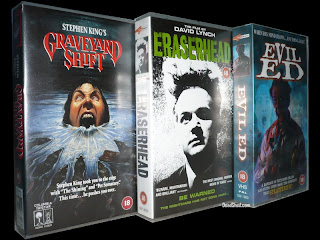

Featuring screaming faces drowning in rat-infested water, severed heads, a screaming, crimson-coated, lunatic film editor, and bold text proclaiming “BE WARNED: The nightmare has not gone away…”, it’s little wonder I was drawn to the box art of these particular titles. Being fifteen at the time – and each video alluringly brandished with an 18 certificate – it fell to my Dad to purchase the videos. The store clerk knew full-well who the videos were actually for (proclaiming knowingly “I see you’re quite the connoisseur”), but they didn’t care. To me there was a sense of danger and fascination about it; I wasn’t legally of-age to be purchasing these videos, and yet by that point I’d been watching 18-rated movies for six whole years (don’t worry – they weren’t anything wildly inappropriate).

I found Graveyard Shift to be an average, but not all that memorable Stephen King adaptation, and Evil Ed to be an utterly barmy horror comedy that really earned the cover blurb “a rampage of exploding heads and flying limbs make this gorefest truly splatterific!” … however, Eraserhead proved to be an entirely different journey.

It was to take me the best part of the ensuing 12 months to get through every one of the 89 minutes in the running time. The film was so bizarre and unsettling to the early development of my cinephile senses that I could only manage 5 or 10 minutes at a time – with gaps of weeks or even months between these sporadic portions. No doubt this extremely fractured form of viewing didn’t help in achieving any kind of understanding of the narrative, but even if I’d viewed it in one sitting, I simply wouldn’t have ‘got it’ one bit aged fifteen with the typical attention span for my age.

More than a decade later, and with The Horror Channel showing Twin Peaks in-full (which I’d never seen before), I truly discovered the work of David Lynch. Blue Velvet (1986) revealed itself as beautifully dark and consuming, while second-attempts at Lost Highway (1997) and Wild At Heart (1990) proved successful. A transcendent witnessing of Mulholland Drive (2001) was followed by the half-baffled enjoyment of Lynch’s most cryptic work to date – the three-hour-long Inland Empire (2006). Aged fifteen, the latter wouldn’t have even been attempted had it been out at the time, but now things were very different – and as such I realised that I would need to return to Eraserhead, which had spent the last 12 years sitting on a video shelf quietly goading me.

I had realised that Lynch’s actual work, and his reputation, are two very different beasts. The content of his work is far easier to decipher once you understand what information in each scene is key to the plot, and what information is unique, inspired, dream-like, Lynchian window-dressing.

The following blow-by-blow account is laid out by time, during which I will posit my personal understanding of Lynch’s most widely analysed, and argued about, film.

Spoilers ahead.


January 15th 2012

8:02pm – Resembling the Lady in the Radiator, I steel myself with a face full of Jaffa Cakes, and press play.

8:04pm to 8:09pm – Henry, full of apprehension, floats in space, but it seems the planetoid going through his mind is in fact a nightmarish ovum. Is this happening now, or is this a guilt-ridden memory – a memory of Henry’s shame, and perhaps even lust, as engendered by the scarred man who instigates the terrified release of Henry’s sperm. Splash down: conception.

It was at this point, I seem to remember, that I first took a lengthy breather from the film as a freaked-out fifteen year-old.

Industrial landscapes that howl with angry, distant machinery – a typically Lynch obsession is birthed on film. Guilt, corruption, intimidation and paranoia seep from every brick, every stained and broken window, and every blackened steel girder.

8:12pm – Ah, the ever-popular zigzag patterned flooring. As the elevator doors slide shut on Henry, I finish my Jaffa Cakes and prepare to enter the nightmare.

8:13pm – “Are you Henry” – we meet ‘The Beautiful Girl Across the Hall’ – the temptress of apartment twenty-seven.

No wonder Henry’s a bit down in the dumps. His shitty one-bedroom apartment roars with the sound of a hissing radiator and features a window without a view.

8:18pm – Henry and Mary X: their relationship is a fractured one amidst a terrifying industrial hell that roars with a cacophony of man-made noise, smoke, decay, loneliness and no small measure of social awkwardness.

8:22pm – Time for dinner at #2416: The wild feasting of puppies upon an exhausted/indifferent mother canine foreshadows news which will bring Henry’s world – and vacation – crashing down around him.

8:25pm – Puppeteering Grandma to mix a salad. An eyebrow takes a subtle step forward in its ascent up my forehead. This is one of those oddball details, with little-or-no underlying meaning, that you so often see in dreams or nightmares that make little sense, but which provide background texture to a scene.

8:27pm – Henry carves the damn-near foetus-size chickens at the behest of crooked-kneed patriarch Bill … if I remember correctly, my fifteen year-old counterpart took another lengthy breather after the close-up of the viscous ooze that gushes forth from the miniscule chicken as its legs flail about. Considering a scene towards the end of the film, perhaps this is another moment of foreshadowing.

8:30pm – A blown bulb, a mother’s invasive questioning and out-of-the-blue personal-space-invading, and a nose bleed. A moment of handheld, free-roaming camerawork unsettles the glaring balance of the usually static, scrutinising camera.

8:34pm – Feeding the horrific premature result of Henry and Mary X’s premarital lust … and receiving a very small worm-like thing in a very small box in the mail. I sense that my fifteen year-old counterpart has gone AWOL once again.

8:37pm – A stormy night to mirror the post-natal torment of Mary X.

8:44pm – Mary X, the woman caged by her youthful indiscretion, flees leaving Henry alone with the monstrous baby … and the temptress next door.

The nightmare escalates – the baby is unwell … it’s sickly wailing, and its diseased appearance, have decidedly disturbed me. The power of the Jaffa Cakes is called upon.

8:52pm – The ‘Lady in the Radiator’, her swollen cheeks, her cutesy come-hither smile, and her dance upon the stage inside Henry’s radiator. Naturally in 1999 such an image simultaneously flew over my head, and exploded it, but I feel I have a better grasp of the scene’s meaning – or at the very least I have an interpretation to proffer.

This vision of Henry’s creation stomps on his sperm – the result of his lust; the very product that rendered him trapped alone with his ailing, premature, inhuman offspring – and so suggests a sense of innocent bliss, a suggestion of what could have otherwise been, before his pre-marital dalliance with Mary X.

8:56pm – Mary X is back in Henry’s ragged bed, crowding him out, but this seemingly normal scene becomes a ghastly unreality as our electric-haired protagonist exhumes giant, slimy, sperm-like worms from between the sheets (from between Mary’s legs … is this a form of afterbirth, or a rejection of his seed?).

As we return to that miniscule worm in the miniscule box that came in the mail, only to be devoured by it whole, I ponder if this worm is in fact a seed of an idea in Henry’s head, and become quite freaked out … I’m so glad I’m not on drugs right now.

9:00pm – The temptress of #27, locked out of her apartment late one night, comes to resurrect Henry’s lust … but where is Mary X, Henry’s new wife, and is this encounter a dream? Henry silences the gruesome progeny.

9:03pm – Infidelity strikes: The pair are quite literally consumed by their actions and sink into the cloudy pool within his marital bed. Sexual seas split – possibly at the moment of climax – but any ecstasy is usurped when the temptress comes face-to-face with the planet-like egg.

9:05pm – “In heaven, everything is fine” – so sings, quite hypnotically, the Lady in the Radiator. The Lady, and Henry’s infidelity, are juxtaposed … however she vanishes after a moment of happiness with him, only to be replaced before his eyes by the scarred man, his dead sperm, and a gnarled and lifeless tree.

9:09pm - A mixture of guilt and threat creeps in as Henry finds himself on trial for his actions.

Then his head falls off – replaced on his shoulders by that of his terrible offspring – as the dead tree secretes a trickling river of blood into which Henry’s severed head suddenly falls.

The head descends from the sky, the skull cracks open, and a child steals it as a homeless man protests.

9:12pm – Over the last 12 years I had almost convinced myself that the following sequence was just in my head, but no – Henry’s decapitated head really is taken to a pencil-making factory where a sampling of his head (much like you’d take a core sample of cheese) is used to make the eraser part … well that explains the title of the film, I suppose.

The dust of his ‘Eraserhead’ wakes him from his hallucinogenic dreamscape where thoughts of his tryst with the temptress plague him … just as two people feverishly dig (or fight?) in the dirt in the alleyway below.

9:18pm through 9:27pm –Henry’s grotesque child mocks him as the girl next door returns home with another man, much to Henry’s dismay. She sees the head of the baby on Henry’s shoulders.

Full of resentment, Henry hacks open the bandages that encase the screaming premature progeny – and he ruddy well stabs it … the disturbance levels in my mind have taken a big old leap … however quite soon both eyebrows find themselves making friends with my hairline as an oozing volcano of goo and sparking electrical outlets precipitate the baby’s head growing to room-consuming size so it can stalk Henry’s terrified form in the strobing Lynchian light … things have most definitely gone a bit mental.

9:28pm – The planet-like egg breaks open as the scarred man wrestles with his jammed levers – then Henry finds himself with the Lady in the Radiator. Hugging her, he discovers that in heaven everything really is fine.

He killed his hideous offspring – and did it in return kill him? – so he can live free of torment forever after.

9:38pm – I watch an episode of Cougar Town to un-freak my mind.


In summary the meaning of the film is quite clear – it’s all about the fear of an impending birth, the dread of on-coming fatherhood, and the torturous and guilty thoughts of a mind-in-fright seeking escape. To me it’s about responsibility versus temptation, and nightmares born out of a fear of everything going wrong – not only with the imminent birth but also your own life, and your relationship with the mother.

Twelve years apart, these two viewings of Eraserhead could not be more different. With age, experience, and even a film degree, comes understanding of a film that flew right over my head in 1999. Back then I struggled with it completely, whereas now I found it quite concise – and I have to say I rather enjoyed it.

Saturday, 14 January 2012

In follow-up to my personal Top 50 most-favourite-favourites...


Having updated my Top 50 personal favourite films of all-time, I’ve decided to throw together a short list of some other flicks – films which I greatly admire, and which have made a great impression upon me.

My film degree opened my mind to a whole variety of cinematic experiences, and ever since then I’ve watched films of all varieties. I can go from a horror movie to a drama, then onwards to documentaries, animation, Oscar-grabbers, dim-witted blockbusters, exacting character studies, experimental shorts, indie flicks, or musicals, and whatever else you have from big names or no names – be they in the English language or not. The point is, if I’m interested in it, then it doesn’t matter what country or genre the film originates from.

My Top 50 list was designed for, and populated by, firm favourites that I could watch at any time, at the drop of a hat – but the following is a short list of more varied films off-the-top-of-my-head that I’ve had to be in the right mood for, but which have left a lasting impression.

Battle Royale (2000)
The Best Years of Our Lives (1946)
Blow-Up (1966)
Brick (2005)
The Cabinet of Dr. Caligari (1919)
Dogtown and Z-Boys (2001)
Downfall (2004)
The Girl with the Dragon Tattoo (2009)
The Good, The Bad, and The Weird (2008)
The House of the Devil (2009)
Hunger (2008)
Ichi the Killer (2001)
Inland Empire (2006)
La Jetee (1962)
Let the Right One In (2008)
Martyrs (2008)
Neighbours (1952)
Pi (1998)
Repulsion (1965)
Singin’ in the Rain (1952)
Stalker (1979)
The Sweet Hereafter (1997)
Touch of Evil (1958)
Versus (2000)