
Just a quick post to say that I've given one of my earlier reviews (from September 2011) a bit of a tidy up and included some screenshots.
To see the updated review of Shout Factory's "Women In Cages" Roger Corman's Cult Classics Triple Feature DVD collection (The Big Doll House / Women In Cages / The Big Bird Cage) click HERE.
Showing posts with label dvd review. Show all posts
Showing posts with label dvd review. Show all posts
Saturday, 24 January 2015

Saturday, 17 May 2014
Bad Girls Behind Bars (Blue Underground Boxed Set) DVD Review
Find more exploitation DVD reviews here.

The 'women in prison' sub-genre goes back as far as the
1930s, but it wasn't until Jess Franco's 99 Women (1969) that the
template changed. A formula was established that was to be followed for many
years – and many films – to come. Innocent girls thrown into a depraved hell
hole of a prison, often in a stifling foreign climate, only to be tortured and
seduced in equal measure by both guards and fellow prisoners. Sadistic wardens
(often times female) would treat their guests of the state like slaves,
and many WIP films involve prostitution or trafficking sub-plots. Toss in
plenty of bare/sweaty/soapy female flesh, prison riots, escape plans, and cruel
injustices resolved with furious vengeance, and you've got the essentials of
the genre.

The locations would change (islands, jungles, Los
Angeles, East Germany, etc), and the tone would shift (action fest,
sexploitation, Naziploitation etc), but common themes remained true across
the board. Repetitive, perhaps, certainly sleazy, these films fought with
sexual politics head-on. Simultaneously exploiting attractive women while also
unleashing them to seek their bloody satisfaction; there are few good men in the
WIP arena. These are the sort of movies in which, when the women do wear
clothes, they might as well not have bothered as their breasts always find a
way to get maximum screen time. Bombastic, low budget, sometimes shocking,
occasionally grotesque, it's a wild-eyed world of hot bodies, cold steel,
burning passions and animalistic insanity.
Read on to discover the delirious depravities of 99 Women,
Women Behind Bars, Bare Behind Bars, Sadomania, and Amazon
Jail.
Click “READ MORE” below to continue the review and see more
screenshots…
Sunday, 21 July 2013
The Bloodstained Shadow (Antonio Bido, 1978) DVD Review

Otherwise known as 'Solamente Nero' in its native
Italy, The Bloodstained Shadow is a twisted and highly atmospheric
giallo directed and co-written by Antonio Bido (Watch Me When I Kill)
set in a 'hypothetical Venice' where murder, Catholicism, and
alternative spiritualism clash in a semi-blasphemous mystery wreathed in mist
and deadly shadows.


Read more giallo reviews here.
Click “READ MORE” below for the review and many more
screenshots...
Sunday, 20 May 2012
The Strange Vice of Mrs Wardh (Sergio Martino, 1971) DVD Review
Find more Shameless Screen Entertainment DVD reviews here.
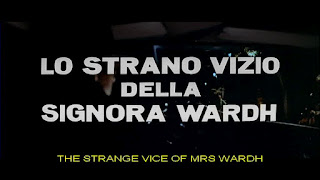
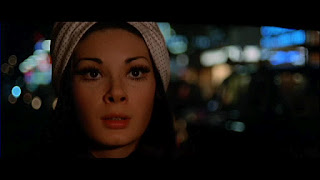
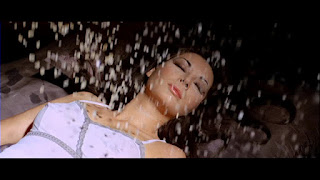
One of Sergio (The Mountain of the Cannibal God,
Torso) Martino's earliest films, The Strange Vice of Mrs Wardh
exhibits a confident grasp of tension-building and exploitable elements, which would
be seen just as strongly in his later work (such as the equally superb Torso aka Carnal Violence). This prime example of the greatest the giallo
genre has to offer, partly inspired by Les Diaboliques (Henri-Georges Clouzot, 1955), follows Julie Wardh (screen siren Edwige Fenech, Strip Nude For Your Killer), the wife of an American diplomat who has been
left stifled and unfulfilled by her marriage, and resorts to fantasising about
her fiery relationship with the sexually aggressive Jean (Ivan Rassimov, Eaten
Alive), who she once again comes face-to-face with when she arrives in
beautiful Vienna.


Similar to Torso, The Strange Vice of Mrs Wardh
kicks off with a first half that is fuelled by frequent sex and violence, with
a second half that focuses on the psychological torture of the female
protagonist. Ninety seconds into the film and you've already been confronted by
bare flesh and a slashing straight razor – the tool of choice for the so-called
'Sex Fiend' killer who is on the loose. During this first half, there's more
bared arses and breasts than you can shake a stick at (Martino deliberately
shot much of this content so the conservative Italian film censors would have
something to edit out – content which has returned for this DVD release, the
first-ever in the UK) – and then by ten minutes in we've had four nude
scenes.

Click "READ MORE" below for the rest of the review, as well as more screenshots.
Sunday, 6 May 2012
Phantom of Death (Ruggero Deodato, 1988) DVD Review
Find more Shameless Screen Entertainment DVD reviews here.
Otherwise known as Off Balance, Ruggero (Cannibal Holocaust, The House on the Edge of the Park) Deodato's vengeance-fuelled thriller, co-written by Vincenzo (New York Ripper) Mannino and Gianfranco Clerici, tells the story of Robert Dominici (Michael York) – a piano virtuoso – whose previously dormant Progeria condition (a disease that ages the victim at an accelerated rate) sends him spiralling into an insane thirst for blood.
Otherwise known as Off Balance, Ruggero (Cannibal Holocaust, The House on the Edge of the Park) Deodato's vengeance-fuelled thriller, co-written by Vincenzo (New York Ripper) Mannino and Gianfranco Clerici, tells the story of Robert Dominici (Michael York) – a piano virtuoso – whose previously dormant Progeria condition (a disease that ages the victim at an accelerated rate) sends him spiralling into an insane thirst for blood.


At first he seeks to hide his condition from those around
him, but soon – as the disease warps his mind – he descends into a
cat-and-mouse game of chase with Police Inspector Datti (a typically skewed
and bewildered performance from Donald Pleasance, well known for his role as
Doctor Loomis in the Halloween franchise), whose obsession at one
point drives him onto the streets to scream out “Where are you, bastard?! I
kill you!” over and over in front of a passing crowd of perturbed Italians.

Click "READ MORE" below for the rest of the review and more screenshots.
Saturday, 3 March 2012
Dellamorte Dellamore (Michele Soavi, 1993) DVD Review
Find more Shameless Screen Entertainment DVD reviews here.
More popularly known as The Cemetery Man in English speaking quarters of the globe, Michele Soavi’s bonkers horror comedy became a cult hit upon its original release – birthed from the equally popular cult of Dylan Dog.
More popularly known as The Cemetery Man in English speaking quarters of the globe, Michele Soavi’s bonkers horror comedy became a cult hit upon its original release – birthed from the equally popular cult of Dylan Dog.


Rupert Everett plays Francesco Dellamorte (meaning St. Francis of Death, when
translated), the guardian of the Buffalora Cemetery. Why does a cemetery
require a gun-toting guardian, you ask? Because in this picturesque Italian
town, on the seventh night after death, the coffins routinely break open,
unleashing “returners” that are dealt
with in a manner of bureaucratic process. For Francesco, who claims to have
only ever read two books in his lifetime (one
he never finished, the other is the phone book), the act of putting down
these walking corpses has, for him, become a dull desk job (literally in one inventively quirky scene).
He seeks something more, something deeper, something with meaning – he seeks
love and romance – and he finds just that all-too-briefly in the form of a
recently bereaved widow (played by the
supernaturally beautiful Anna Falchi).


Teamed with a bumbling oddball of a gravedigger called Gnaghi,
Francesco soon becomes haunted by the vision of his love in the faces of the
women he meets, as all around him entire gangs of teens and busloads of Boy
Scouts are offed in darkly comic tragedies only to be gunned down en masse when
they inevitably return. At times Soavi’s film is like a spaghetti western
clashing with the early works of Sam Raimi and Peter Jackson – the humour is
knowing and twisted, and the visuals are simultaneously beautiful and bravura.
As Francesco is driven to ‘getting ahead
of his work’ by turning to murdering the living, a severed head attacks the
Mayor from a tooth’s-eye-view, a bizarre solution to a penile phobia is
discovered, and the very nature of life, love, death, and the infinite beyond
your own borders are examined. This is indeed a deliciously strange journey
that mixes romanticised existentialism with sanguineous evisceration, that
truly lives up to the name Dellamorte
Dellamore.


Typically for an Italian film, it looks absolutely splendid.
Massimo Antonello Geleng’s production design is intricate and inventive, cast
in a world of forever blowing wind that sweeps dead leaves and flowing veils
through the air, and Maurio Marchetti’s cinematography is sumptuous (he previously worked on Apocalypse Now). However the script (by Gianni Romoli and Tiziano Scalvi, the latter of whom authored the
source text Dylan Dog) deftly
matches the romanticised lunacy of the imagery, with a wry wit (“I’d give my life to be dead!”) and a
lovelorn sense of melancholy. Gore hounds will also find some significant joy
here as there’s more gruesome headshots abound than you can shake a stick at.


Shameless Screen Entertainment – in their signature
stand-out yellow packaging – return with a nicely put together package which,
while not boasting a weighty tome of extra features, exhibits an attention to
detail and respect for lost gems that has rightfully earned them a reputation
for quality releases. An audio commentary from director Michele Soavi and
writer Gianni Romoli, trailers, a photo gallery, English and Italian audio
options, and a booklet featuring a personal memoir of the movie from respected
film writer Alan Jones round out the package.
It should be noted however, that there is a persistent stutter to the video transfer. It's not noticeable in static shots, but is evident during sweeping camera movements. It's certainly not a deal breaker, but it is an annoying frustration.
It should be noted however, that there is a persistent stutter to the video transfer. It's not noticeable in static shots, but is evident during sweeping camera movements. It's certainly not a deal breaker, but it is an annoying frustration.
To see other reviews of Shameless Screen Entertainment releases, use the following links:
Strip Nude For Your Killer (Andrea Bianchi, 1975)
What Have They Done To Your Daughters (Massimo Dallamano, 1974)
Killer Nun (Giulio Berruti, 1979)
Torso (Sergio Martino, 1973)
Night Train Murders (Aldo Lado, 1974)
Saturday, 21 January 2012
Night Train Murders (Aldo Lado, 1974)
Find more Shameless Screen Entertainment DVD reviews here.
The following is the third of three reviews for the "Shameless Slasher Nasties Box Set" - it's a 3-disc DVD comprised of Killer Nun, Torso, and Night-Train Murders.
The following is the third of three reviews for the "Shameless Slasher Nasties Box Set" - it's a 3-disc DVD comprised of Killer Nun, Torso, and Night-Train Murders.

Like Killer Nun (included in this box set), Aldo Lado’s
riff on Wes Craven’s The Last House on
the Left (1972) found its way
onto the Department of Public Prosecutions list of 72 banned video nasties in
the 1980s. However, similarly to Berruti’s film, Night Train Murders was later acquitted (33 titles in total were acquitted, leaving 39 that were ‘liable to
deprave and corrupt’ anyone who viewed them).

While the trailer seems to suggest a lurid and fast-paced
thriller, Lado’s ‘rape and revenge’
flick is in fact much more reliant on suspense and slow-build tension – and a
script loaded with brutal social commentary. Furthermore, despite Lado claiming
to have never seen Craven’s vicious Vietnam-weary The Last House on the Left (itself
heavily inspired by Ingmar Bergman’s 1959 film The Virgin Spring), there are numerous similarities between the
two films – two girls fall victim to a gang of thugs (one of whom is a junkie) only for them to in-turn fall victim to
the upper middle class parents of one of the victims (one of whom is a Doctor). That said, the two films differ in two
key ways – Craven’s documentary-like film is far more directly plotted, while
Lado’s visually luxuriant film possesses far more twisted characters.

Opening amidst the heavily populated consumer haven of a
German shopping district on Christmas Eve, Lado’s social criticism gets off to
an early start – the safety of this scene getting interrupted when the two
antagonists (“Blackie” and “Curly”) mug
a boozy Santa Claus. They escape the police by hopping aboard a departing train
– the same train that is carrying Margaret and her friend Lisa on their way to
spend the holidays in Italy
– and so a night of depravity is set in motion.

Amongst the passengers are a cross-section of 1970s European
society – including happy families, students, Catholic priests cheating at
chess, and a group of well-heeled adults discussing the very nature of
morality, democracy, and if there is a middle-ground between liberalism and
totalitarianism. Indeed it is within this last group that we meet one of the
key antagonists – ‘The Lady on the Train’ – an upper middle class woman who
hides her sexual perversions in her handbag and behind her veil. It is with
this character that the social criticism of the script is most potent,
unleashing her inner demons via a toilet-bound tryst with Blackie – in this way
depravity is almost treated like a sexually transmitted disease that brings out
the worst in her suppressed character. It’s quite literally a clash of the high
society and the seething proletariat.

As the film progresses, the social commentary continues to
come thick-and-fast as the tension slowly builds – seemingly happy marriages
are shown to be on the rocks, and the very nature of temptation and shame are
embodied brilliantly in the figure of a bourgeois voyeur. Indeed, the film
really explodes once we’ve swapped trains and the central protagonists and
antagonists find themselves secreted away in a booth with each other – and it
is here that Ennio Morricone’s score (central
to which is a chilling, stalking harmonica) creates an almost unbearable
amount of anxiety as events take a dramatic and violent turn for the worse.

Cast in a sinister and seductive blue light, Gabor Pogany’s
cinematography expertly melds vice, violence, and virgin innocence, while
Alberto Gallitti’s exceptional editing fizzes with inspired cross-cutting and
sound design that blends two distinct worlds into a distillation of the
troubled underbelly of (at the time at
least) modern European life. While The
Last House on the Left focussed more on up-front violence, Night Train Murders instead opts for
chillingly lifting the veil on the potential moral squalor inside any one of us
– and it is precisely this kind of rich thematic texturing that proves Lado’s
film to be an extremely rewarding entry in the ‘rape and revenge’ sub-genre.
Shameless Screen Entertainment do themselves proud with a
clean and crisp transfer, and a nice audio presentation that preserves all of
the Godfather-like use of clattering
train wheels on the soundtrack; trailers round out the package. The 3-disc 'Shameless Slasher Nasties Box Set' also comes with an essay insert from noted film writer Kim Newman (providing brief but informative context), and the set itself comes with impressive cover art that mimics a rental videotape (complete with "Be Kind and Rewind" sticker).
Friday, 20 January 2012
Torso (Sergio Martino, 1973) - DVD Review
Find more Shameless Screen Entertainment DVD reviews here.
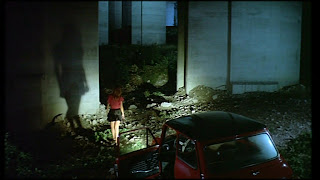
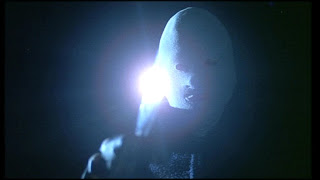
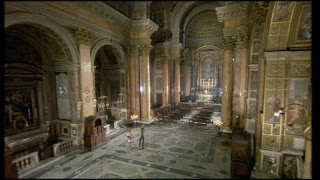

The following is the second of three reviews which I'll be posting for the "Shameless Slasher Nasties Box Set" - it's a 3-disc DVD comprised of Killer Nun, Torso, and Night-Train Murders.

Like Killer Nun (included in this box set), this Italian
giallo flick is presented uncut in anamorphic widescreen with a handful of
newly re-inserted scenes that were previously expurgated – scenes that provide some extra connections between the dots. Sergio Martino had previously delivered The Strange Vice of Mrs Wardh (1972) starring giallo legend Edwige
Fenech, and would go on to unleash Mountain
of the Cannibal God (1978)
starring Stacy Keach and a certain Bond Girl by the name of Ursula Andress.
However Torso (appropriately sub-titled “Carnal
Violence”) has perhaps brought the director the most acclaim in wider circles, as it
stands as an excellent example of the slasher movie during the early gestation
of the sub-genre.

In advance of early American slashers like Black Christmas (Bob Clark, 1974) and The
Texas Chainsaw Massacre (Tobe Hooper,
1974), Martino’s film features examples of some of the most common themes
and iconography found in such fare. Writers such as Carol J. Clover, Reynold
Humphries, and many more have discussed these elements – particularly the
so-called ‘final girl’ – the one
female to make it out alive due to her superior moral standing. Indeed here the
femme who escapes fatal consequences is played by Suzy Kendall – who also
starred in Dario Argento’s superb debut The Bird with the Crystal Plumage (1971).
However, Martino and his screenwriting partner Ernesto
Gastaldi, and his Director of Photography Giancarlo Ferrando seem far more
interested in gazing at any one of the other girls who populate the film’s bevy
of gorgeous babes – gals who are no strangers to getting their kit off at a
moment’s notice. That all said, once we move into the second half of the movie
the focus finally lands squarely on Kendall’s shoulders – indeed it’s very much
a film of two halves.

The first half rapidly makes it way through a whole
succession of tense stalkings, bared breasts (even in the very first shot!), violent murders, and no end of red
herrings and possible suspects. True to gialli, practically anyone is a suspect,
and in a film populated by sex-obsessed men who lustfully/creepily leer at the
central female cast non-stop, there’s no end of potential slashers. It is then
with the second half that the pace slows and the spotlight lands on mystery and
suspense – indeed a triple-slaying is entirely off-screen – but Kendall more
than makes up for it as she becomes a captivating captive.

Making exceptionally good use of locations, Martino’s film
certainly isn’t lacking in the looks department, but pleasingly it’s no “F
Grade” student either. “Carnal Violence” might not be especially
catchy as a title, but it matches the content perfectly. Themes of sex, death,
and where the two collide are central to the plot, which also features an
underlying dose of socio-political commentary. Not only is there a clear gender
gap on display (many of the surviving
males are sexually defunct, unlike the females), but so too is there a
distinct generation gap (the students
versus the ineffective police).

Shameless Screen Entertainment provides a solid transfer,
however it isn’t without some problems: the audio source shows wear & tear
at times, as does the video source – but being that this is the sort of film
that epitomised the video nasty era (while,
incredibly, never becoming one!), the slightly rough look only adds to the
experience. We’re unlikely to get a prettier looking Torso in the future; finally, a series of trailers round out the
disc. The 3-disc 'Shameless Slasher Nasties Box Set' also comes with an essay insert from noted film writer Kim Newman (providing brief but informative context), and the set itself comes with impressive cover art that mimics a rental videotape (complete with "Be Kind and Rewind" sticker).
Slasher fans and giallo fans are both exceedingly
well-served here, as Sergio Martino crafts a murder mystery that is as sleazy
as it is involving; a must-see.
Thursday, 19 January 2012
Killer Nun (Giulio Berruti, 1979) - DVD Review
Find more Shameless Screen Entertainment DVD reviews here.
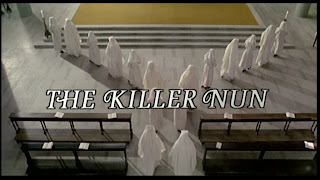
Presented fully uncut for the first time in the United Kingdom, and including freshly re-introduced scenes previously excised by the producers, Shameless Screen Entertainment bring us a nicely spruced-up presentation of Giulio Berruti’s Killer Nun. Previously one of the entries on the Department of Public Prosecution’s list of video nasties here in the UK, the film is based on a true story.
The following is the first of three reviews which I'll be posting for the "Shameless Slasher Nasties Box Set" - it's a 3-disc DVD comprised of Killer Nun, Torso, and Night-Train Murders.

Presented fully uncut for the first time in the United Kingdom, and including freshly re-introduced scenes previously excised by the producers, Shameless Screen Entertainment bring us a nicely spruced-up presentation of Giulio Berruti’s Killer Nun. Previously one of the entries on the Department of Public Prosecution’s list of video nasties here in the UK, the film is based on a true story.
Oftentimes you read the words “based on a true story” and it’s anything but, however Killer Nun is based on a case of a
Belgian nun who underwent brain surgery and consequently became a morphine
addict to assuage the torment of persistent headaches and mood swings. In order
to feed her addiction she would ‘help
along’ patients in her care who were near-to-death, only to steal their
precious belongings and pawn them in the city for money to buy the drugs she craved.
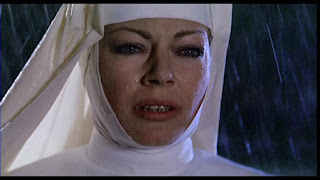

So far that’s the majority of the plot of the movie right
there – although nowhere in the true story were there actual murders, torture,
or bisexual nuns played by heavy-chested Playboy models. Anita Ekberg (La Dolce Vita) plays Sister Gertrude –
the morphine-addicted nun – while Paola Morra plays her sexually obsessed junior Sister Mathieu (the actress was the Italian Playmate of the Month of February 1978).
Today the film is much tamer than its reputation or title
might suggest, however it’s a relatively high-minded film that dares to mix in
a little social commentary about institutionalised cover-ups in religious
organisations. It’s perhaps more akin to What Have They Done To Your Daughters (Massimo
Dallamano, 1974) in the respect that it’s not quite as lurid as you might
expect from the title – unlike Strip Nude For Your Killer (Andrea Bianchi,
1975), which is precisely as sleazy and violent as you would anticipate.
That said, considering the juxtaposition of murder with religion, and sex with
Sisters of the Cloth, I can picture how it would have historically been considered quite the
controversial film in certain quarters – indeed to some, for those very
reasons, it could remain offensive to this day.

Giulio Berruti and Alberto Tarallo’s script plays with
thematic substance and a gradual pace, and while it may be comparatively light
on sex and gore unlike some of its peers, the film is more then backed-up by a
quality production. Tonino Maccoppi’s cinematography is – typically for Italian
cinema – beautiful, and is nicely complimented by Mario Giacco’s editing, and
Alessandro Alessandroni’s exceedingly memorable score.
Shameless Screen Entertainment’s DVD offers a lovely
restored print, trailers, and a brief chat with star Anita Ekberg. The 3-disc 'Shameless Slasher Nasties Box Set' also comes with an essay insert from noted film writer Kim Newman (providing brief but informative context), and the set itself comes with impressive cover art that mimics a rental videotape (complete with "Be Kind and Rewind" sticker).
Fans of this
kind of cinema should be pleasantly surprised by Killer Nun, and would do well to give it a spin.
Subscribe to:
Posts (Atom)




 Posts
Posts

